Friday, 27 August 2010

The Book of Margery Kempe

What do seminarians do on their summer holidays?

Well now, that would be telling. But I will break up our complete lack of summer-time blog articles, with a little indulgence into one of my passions.

This seminarian went to a second-hand bookshop in the great East Anglian city of Cambridge, and found a little 1936 print of a very much older book indeed.

I spent a portion of my time at university translating mediaeval documents, such as wills and deeds (not for fun...it was a course module!). One place-name I came across was Lynn episcopi. This caused me a few moments of angst until I realised that, of course, it referred to King's Lynn, called, before the Reformation, Bishop's Lynn.

Bishop's Lynn, a town of our diocese, was, 570 years ago, the home of a certain woman named Margery Kempe. A book of her life, unimaginatively yet charmingly entitled, was that which I discovered in my county-town last week.

I have never before read The Book of Margery Kempe, though I have seen novel snippets found in the various tomes of Professor Duffy, and the like. The book is a cross between the life of a saint, and a 15th century episode of Eastenders.

Written down by a priest, she tells the stories of her life: arguments with her husband, her lustful temptations at evensong, her conversion to holiness, her pilgrimages, her meetings with bishops, friars, vicars and anchoresses, such as Julian of Norwich, who, regular followers will remember, was the subject of Oscott's Lenten reading this year.

It also recounts the course of her spiritual life, which, though mediaeval, is still, for me at least, inspiring and thought-provoking, worthy to be read in our own time. She reminisces of one occasion of her attending Mass and receiving Holy Communion (which she did regularly, so rare in her times, she had to seek permission from the Archbishop of Canterbury). I'd like to share with you her personal prayer for these occasions, which she shared for time immemorial:

Lord, as surely as Thou are not wroth with me,
grant me a well of tears,
whereby I may receive Thy Precious Body
with all manner of tears of devotion to Thy worship
and to the increase of my merit;
for Thou art my joy, Lord,
my bliss, my comfort and all the treasure I have in the world;
for other worldly joys covet I not, but only Thee.
And therefore my dearworthy Lord and my God,
forsake me not.

Tuesday, 13 July 2010

Ad multos annos!

It's funny what happens when you don't write on a blog for a while...

Back in June, the twenty-sixth of June that is, our fifth year brother, Pádraig, was ordained to the diaconate in Oscott Chapel, along with his peer of the archdiocese of Birmingham, Craig, by the Ordinary of that See, Archbishop Bernard Longley. We always enjoy the Archbishop's visits to the college, and for him to ordain our new top year was a great blessing, not only for our seminary community, which has two wonderful new deacons to minister to our manifold needs, but to both our dioceses, and to the Church. Congratulations on your ordination!

The ordinations to the diaconate happen, of course, every year, and, traditionally, mark the end of term, and the beginning of summer. This year, however, was different. A week after the ordinations, we seminarians returned to find the Rector's lawn festooned with teepees, and, very soon, we were to be over-run by young people in tents. It was the weekend of Invocation 2010, the first large gathering of people discerning a particular vocation in the Church as priests or religious. There were a variety of liturgies, workshops and talks, but, principally, it was an arena for the Holy Spirit, and it was evident that he was at work in the hearts of many of the people who were present. The Chapel was packed full to brim, and over, for Mass and the Offices, and said new deacons were granted a baptism of fire, and managed to tick off three of our nation's Archbishops at the event, +Bernard, +Peter (close to our hearts round these parts, of course), and +Vincent.


These two chappies made an appearance with our own Bishop Michael, this last Saturday, 10th July, in our Cathedral in Norwich. For our two seniors have managed to escape from seminary and be ordained priests!

The purpose of seminary is not to live in a permanent religious community, which can be a danger, though, thank God, is not the case in reality. A seminary is for the formation of men for the priesthood: to sanctify the Christian people, and to offer sacrifice to God.

It was with great joy, and - I'm sure I'm not only speaking for myself - great pride, that two of our brothers and friends, who began this blog, and indeed, set the ball rolling for the current crop of E.A. Seminarians, were ordained to the sacred priesthood.

It was such a beautiful sight: the Cathedral packed full of priests, deacons and lay faithful, surrounding the Bishop, as Michael and Luke were called forward to be ordained by him. The prostration, the promise of obedience, the laying on of hands, the clothing with priestly vestments, the anointing with Chrism, presentation of the chalice and paten, and the first concelebration of Holy Mass, brought several tears to my eye, and I'm sure I wasn't the only one!

It could be a fairy-tale, but it isn't, it's real: two new priests for the Church in East Anglia! Two good and holy men have offered their entire lives for the service of God's people in our diocese.

Ad multos annos, Father Luke and Father Michael!

May God bless your priestly lives, and may we all remember you in our prayers.

As soon as we get more pictures of the ordination, the first Masses in Peterborough, Ipswich and Walsingham, we'll write lots more! Do send in your snaps, if you have any you would like to share, to our e-mail: eastanglia@live.com.

Sunday, 20 June 2010

Acolytate

June is proving to be a very busy month.

It is topped and tailed with Quarantore, and next week, we conclude the month of the Sacred Heart with ordinations to the diaconate.

Today, however, has been an important event for year three, including our very own Henry, who received the Ministry of Acolyte at Mass this morning. Two students from the archdiocese of Birmingham, and one student from the diocese of Nottingham received the ministry, and a Birmingham student received the Ministry of Lector. Both of these, formerly minor orders, are conferred upon men, who, usually in preparation for priestly ordination, become related to Mother Church's ministry in a particular way. As the bishop said to Henry and the others during the rite, "it is your responsibility to assist priests and deacons in carrying out their ministry, and as special ministers to give holy communion to the faithful at the liturgy and to the sick."

Pretty self-explanatory, really! Oscotian tradition dictates that those receiving this ministry 'take-over' the serving of those acting as their 'vicars' for the Liturgy of the Word. Needless to say, perhaps unintentionally, Henry took over my role; so we kept it East Anglian.

Congratulations to all those who received their ministries today.

Tuesday, 8 June 2010

New Looks

There have been a few changes afoot down ol' eastangliaseminarians.blogspot.com.

Along with a new experimental look, we have also installed a hit-counter, which allows us to see how many people are visiting our site, and various demographics. Also, to protect security, after a recent wave of spam, you will notice, hopefully, more control over comment moderation.

Do give your opinion, if you have one!

--- --- --- --- --- --- --- --- ---

In other news, Michael's reign as Dean of Seminarians came to an end just before half-term. However, the college swiftly elected a successor, a certain Pádraig, who, in what can now be called a tradition, will ensure East Anglia remains at the very pinnacle of the collegiate crème. Best of luck for your term in office!

Who lives and rains

We emerged from half-term last week, and, in preparation for the celebration of Corpus et Sanguis Christi on Sunday, the whole house entered into a period of forty hours Eucharistic exposition, which, in an original Italian manner, is styled Quarantore. It was a great privilege to know that the Blessed Sacrament was exposed and being adored almost next door to my bedroom all weekend!

As you can see from this picture of the chapel, we made sure that the Blessed Sacrament was suitably framed with a medley of beautiful flowers and candles.

After an early Mass on Sunday morning, Archbishop Longley visited the college, and presided over a Eucharistic Procession, in typical Corpus Christi style. The chapel was full of guests from far and wide who came to join us for the celebration, and, in spite of the rain, spirits were high throughout, and the sense of devotion and reverence was awesome. From our vantage-point from our seminary-on-the-hill, the Archbishop raised the monstrance containing the Blessed Sacrament over Birmingham, and the city was blessed; the heavens, too, provided its own, unique, sign of approval. Fortunately, Our Lord was protected by a canopy throughout, and stayed nice and dry.

Though we are away for Corpus Christi next year, we hope to continue the tradition of public processions. This was my first Quarantore experience. Maybe some of our readers would like to share anything similar from their own parishes from this last week.

Wednesday, 12 May 2010

Diocesan Pilgrimage to Walsingham


It's very rare that many photo opportunities crop up, for some reason, but here is a nice one, taken from our recent Diocesan Pilgrimage to Walsingham, not only with all the E.A. Seminarians, but also with Bishop Michael, and Our Lady herself.

Tuesday, 20 April 2010

Gone fishin'

The house was lucky enough this past Sunday to welcome Fr Gerard Bradley, Spiritual Director of Wonersh, to give a day of recollection. As the season of Easter moves on, and the impact of Easter day itself begins to fade a little in our minds, it is the perfect time to consider that all the work we put in during Lent should be reaped about now.

Fr Gerard used the Gospel of day, which is the story from John 21, including that beautiful dialogue between the risen Jesus and Simon Peter..."do you love me?"

The world of the apostles has fallen apart, and they are racked by the memory of their denials of Christ, especially Peter, who says that he's going fishing.

The fishermen are experts; they fish in the night when the fish are near the surface (they are in the shallows, like the faith of those who fish them). But fishing in the dark, they cannot see anything.

The day dawns; the sun is just up:

The sun is risen.

The Son is risen! Alleluia!

He is out of the depths of sin and death: this is the day!

Wake up! Alleluia!

Jesus is the person with the fullness of light.

Our faith is the light of the risen Christ which dawns inside, allowing us to see as the Father sees. The fishermen do as he says, and they succeed. Jesus is no fisherman. Yet the expert fishermen accept what he has to say, accepting his orders which are beyond their natural talents and abilities, beyond the security of their capacity. They have failed, but now they succeed: the Christian life is based on disaster and failure, for though these we grow.

Christ is doing the fishing here.

They cast their nets on the right side of the boat, like he says. They use their right side, their right hand.

They will bless with their right hand

They will forgive with their right hand.

They will anoint with their right hand.

Those in the household of grace are woken by grace. Many Christians have not woken up yet, and their faith seems undeveloped, like they are looking at this scene through the keyhole.

But Christ is the door.

He is the daystar! Alleluia!

Jesus' deepest desire is to be fruitful in the world... through you.

So cast your nets, in the ways he is asking you to.

Friday, 19 March 2010

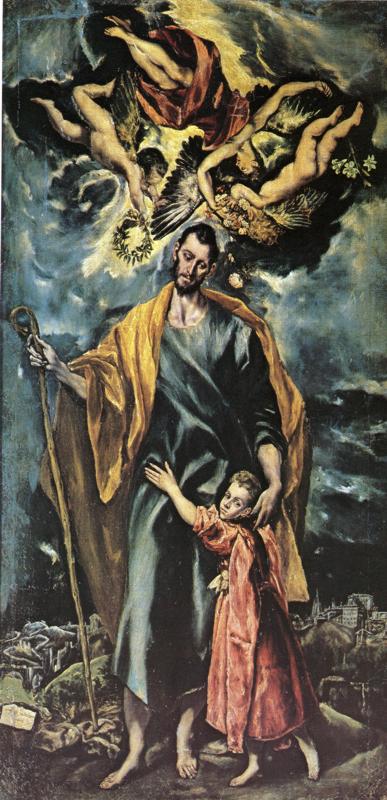
Happy St Joseph's Day!


From St Bernardine of Siena's sermon in today's Office of Readings:

"What then is Joseph’s position in the whole Church of Christ? Is he not a man chosen and set apart? Through him and, yes, under him, Christ was fittingly and honourably introduced into the world. Holy Church in its entirety is indebted to the Virgin Mother because through her it was judged worthy to receive Christ. But after her we undoubtedly owe special gratitude and reverence to Saint Joseph.

In him the Old Testament finds its fitting close. He brought the noble line of patriarchs and prophets to its promised fulfilment. What the divine goodness had offered as a promise to them, he held in his arms."

Friday, 12 March 2010

Acolyte Retreat


Tomorrow the third year go away on a weekend pre-Acolyte retreat to Mount St Bernard's abbey. The ministry of Acolyte, which we receive in the summer, is a ministry of assisting the priest and deacon in the celebration of Mass, and acting as an extraordinary minister of the Eucharist where the need arises. We went to Mount St Bernard's for our Lecorate retreat last year and had a great time - the Cistercian abbey is situated in a beautiful part of Leicestershire, and it is inspiring to see the self-sufficiency of the monks, who keep cows, chickens and bees among other things as a way of earning their living. Oh, and of course they get up at 3.30 in the morning to pray Vigils! Let's see if we can make it to that (though I at least plan on going back to bed afterward...).

Wednesday, 10 March 2010

True Humanity


I referred in a previous post to Pope Benedict's recent 'lection divina' to the priests of Rome, in which he reflects on the nature of the priesthood in the light of the Letter to the Hebrews. In one point during the meditation he touches on the Church's anthropology, her understanding of what it is to be human:
.
'[...] the priest must be man, human in all senses. [...] the question of "what man is" is obscured by the event of sin that hurt human nature even to the quick. Thus people say: "he lied" "it is human"; "he stole" "it is human"; but this is not really being human. Human means being generous, being good, being a just person, it means true prudence and wisdom.'

Sin never makes us more human, as the Pope emphasises, but rather it makes us less human. How can this be so? Well, we must understand humanity in the Thomistic sense as having a nature and purpose given it by God. What are we here for? To know, love and serve God, and to be happy with Him. If we are sinning therefore - not knowing, loving or serving God - we are falling short of our natural purpose, and therefore falling short of our humanity.

There is indeed another common understanding of human than the one used to excuse sin. People often say as a compliment of a person that 'he is a true human being', meaning, he has a heart, he understands people, he is compassionate. This is what the saints were, themselves examples of true humanity, not staid and boring and plasticine like some depictions of them in convenional art, but radiating the beautiful life of God which we are all called to share in. Maybe we can keep this in mind as we persevere in our lenten penances, knowing that the closer we come to God the more free we are to be who we were really created to be.