Congratulations and best wishes to Archbishop Vincent Nichols for his appointment to Westminster. We hope his ministry there will be extremely blessed, and we will keep him in our prayers especially. It will be nice to have him come, as usual, to celebrate the Easter morning Mass at Oscott this year, as it will be one of the last times we see him in his present capacity!
"God is alive. He has created every one of us and he knows us all. He is so great that he has time for the little things in our lives: “Every hair of your head is numbered”. God is alive, and he needs people to serve him and bring him to others. It does makes sense to become a priest: the world needs priests, pastors, today, tomorrow and always, until the end of time." - Pope Benedict XVI
Monday, 6 April 2009
Back in the loop
We've finished our retreat from last week, which for me at least was a very fruitful one - it's always nice to get away from work and be generous with our prayer! This week also is without any lectures, so that we can take part in the litugies of Holy Week, particularly at Birmingham Cathedral, and enter into the spirit of Passiontide. We were at the Cathedral yesterday for Palm Sunday, a packed Mass, and today we had a communal Stations of the Cross. The priest at our seminary Mass today spoke in his homily of our need to echo the extravagance of Mary for Jesus in today's Gospel, when she pours the precious ointment on Him. We too can use this week to show extravagant devotion to the Lord.
Congratulations and best wishes to Archbishop Vincent Nichols for his appointment to Westminster. We hope his ministry there will be extremely blessed, and we will keep him in our prayers especially. It will be nice to have him come, as usual, to celebrate the Easter morning Mass at Oscott this year, as it will be one of the last times we see him in his present capacity!
Sunday, 29 March 2009
End of the Devout Life!
I don't mean the seminary has suddenly become immoral, but that we've finished the Introduction to the Devout Life which we've been reading for the past four weeks. It's been a wonderful chance to read a spiritual classic as a community, and to see how it has become a part of our life here, whether it be in mealtime discussions or in priests' homilies. But more than that, St Francis has a greater knowledge of the human person, of what it is like strive in the way of Christ, and his advice is not high-flown or abstract, but suitable to our daily lives. I shall no doubt be returning to him in the future!
Here is last reading from St Francis de Sales:
Consider the eternal love which God has had for you; for already before our Lord Jesus Christ, as man, suffered on the cross for you, his divine Majesty foreknew you in his sovereign goodness and loved you infinitely. But, when did he begin to love you? When he began to be God. And when did he begin to be God? Never, for he has ever been God, without beginning and without end; and so he has always loved you from all eternity: and therefore he prepared the grace and favours which he has conferred on you.
Tomorrow we start a five day silent retreat before Holy Week. (Judging by the posts recently, you might think we're always on retreat, but Mount St Bernard's was just for the 2nd years - this is our annual Lenten retreat for the whole house.) It will be nice to be silent and reflect on what God has been doing in our lives. Inevitably, this means no blogging for a week... See you on the flipside!
Thursday, 26 March 2009
Annunciation, essay, and St Francis on spiritual barrenness
Okay, that's quite a title.
First off, apologies for not posting in the last few days, despite the Lenten resolution. A large part of it is my hectic rush to finish an essay for tomorrow, and I haven't been organised enough to post anything.
Secondly, I hope that you all had a wonderful Solemnity of the Annunciation yesterday. I certainly did!
Today St Francis talks about something that many people struggle with, which is spiritual barrenness - a sense that God has left me, and no longer gives me spiritual consolations. Many people automaticallly call this 'the dark night of the soul,' but I think the term is used too sweepingly. Certainly very holy people like Blessed Teresa of Calcutta spent large parts of their lives without feeling close to God, and this made their faith their charity all the stronger. For whatever reason, God can decide to withhold spiritual consolation from some people, even when in reality they are very close to Him. But St Francis says there are many reasons why we might feel far from God.
i) When we become complacent about the spiritual consolation He gives us. Then His seeming 'removal' from us teaches us humility.
ii) When we become too attached to material comforts, and as a result become sluggish in our devotion.
iii) When we are not honest with ourselves or our confessors about our spiritual lives.
iv) when we don't use the consolations we have been given to grow in virtue (which is the point of consolations)
But whatever the reason for spiritual barrenness, and even if we are not the cause of it, St Francis says we should not be anxious about it:
...nothing is so useful, nothing so profitable in such dryness and barrenness, as to have no attachment to the desire of being delivered from it. I do not say that we may not entertain wishes for deliverance; but I do say that we must not set our hearts upon it, that we must resign ourselves to the mercy of the particular providance of God, so that he may make use of us, as long as it pleases him, in the midst of these thorns and among these deserts...
...our actions are like roses, which, though they have more external grace, when they are fresh, yet give forth a sweeter and stronger scent when they are dry: for just in the same way, though our works done with tenderness of heart are more agreeable to ourselve - to ourselves, I say, who only consider our own pleasure - yet, when they are done in a state of dryness and barrenness, they have a sweeter scent and greater value before God.
Monday, 23 March 2009
St Francis on Sadness
Well, we're back from our retreat, and it was a lovely time away. We spent some time discussing the ministry of lector with the rector and spiritual director who accompanied us, and had a time of lectio divina as well (meditating on
a particular scripture passage and sharing what God is saying to us through it). We also attended the monks' liturgy throughout the day, and I even managed to go to their first daily office (Vigil's) at 3.30 in the morning... though whereas they stay up when they're finished, I went back to bed! On top of their communal prayer, and the many guests who they welcome to the monastery, they have a farm from which they get much of their own produce: milk, eggs, even honey. It seems like a very wholistic and happy life that they lead, though not without hardships!
St Francis de Sales has been saying some wonderful things in the Devout Life lately. Today he talks about sadness:
The enemy takes advantage of sadess to tempt the good... [he] is pleased with sadness and melancholy, because he is sad and melancholy himself, and will be so for all eternity; and therefore he wishes everyone to be like himself.
Evil sadness troubles the soul, leads it into disquietude, gives birth to inordinate fears, causes a distaste for prayers, dulls and oppresses the brain, deprives the soul of counsel, of resolution, of judgement and of courage, and weakens her energy: briefly it is like a hard winter which takes away all the beauty from the earth, and benumbs all living creatures; for it takes away all sweetness from the soul, and makes her almost paralysed and powerless in all her faculties.
If you should ever find yourself attacked by this evil sadness, make use of the following remedies: If anyone is sad, says St James, let him pray; prayer is a sovereign remedy, for it lifts up the soul to God, who is our only joy and consolation. But when you pray, make use of aspirations and words, whether interior or exterior, which tend to confidence in God and love of him, as: O, God of mercy! O God most good! My loving Saviour! God of my heart!...
Vigorously resist inclinations to sadness, and though it may seem to you that whatever you do in such a time is done oddly, sadly and half-heartedly, yet do not omit to do it; for the enemy, who tries to make us weary of good works by sadness, seeing that we do not fail to do them, and that when they are done with repugnance they are more meritorious, ceases to trouble us any longer.
Sing spiritual canticles, for the evil one has often been forced to desist from his efforts by this means...
It is good to occupy oneself with exterior works and to vary them as much as possible, in order to divert the soul from what causes the sadness, to purify and warm the spirit, sadness being a passion of a cold and dry nature.
Saturday, 21 March 2009
Prayer Intentions
Please pray for the Second Year as we go off to Mount St Bernard's abbey in Leicestershire for a day's retreat, in preparation for lectorate (the ministry of reading and proclaiming Scripture). We will receive lectorate, God willing, in June.
Also, remember the kids from the various North Staffordshire schools who came on Monday for a football tournament, organised by the diocesan vocation's office. Pray that they will discern God's vocation for them. And pray finally for David Palmer, who I'm sure many of you will know has had his application for priesthood turned down by Rome (not because of anything he's done, but because, as he said, his circumstances are somewhat unique). It must be extremely hard for him at this time, having been here at Oscott for almost 2 years, so pray that he may be given direction about what to do next.
Friday, 20 March 2009
We are crucified to the world
From the Devout Life this morning:
Let us pay no attention to this blind world, Philothea: let it cry out as much as it will, like an owl, to disturb the birds of the day. Let us be firm in our designs, unswerving in our resolutions; perseverance will make it clear whether it be in good earnest that we have sacrificed ourselves to God, and undertaken the devout life. Comets shine with a brightness that is almost equal to that of planets; but comets disappear in a very short time, since they are only transitory fires, whereas planets have a lasting brightness: even so hypocrisy and true virtue are very like one another externally; but the may easily be distinguished from one another, because hypocrisy does not last long, and vanishes like rising smoke, but true virtue is always firm and constant. It is no small help to the consolidation of our devotion in the beginning, if we meet with blame and with calumny on this account; for by this means we avoid the danger of vanity and pride, which are like the midwives of Egypt, to whom Pharoah gave orders that they should kill all the male children of Israel on the very day of their birth. We are crucified to the world, and the world ought to be crucified to us; it holds us to be fools, let us hold it to be mad.
I guess the hardest thing about practising the virtues is the criticism we may receive from others for doing so. St Francis is saying that we should not be worried about how society judges our actions, if we know them to be right and good. He is not saying that we should be awkward or contrary for the sake of it, as if it were our christian duty to get people's backs up. Opposition will no doubt come if we are radically living the Gospel, as it came to Jesus, but we are not looking for it. We are simply trying to get on with what God wants for us at this point in time. And that's not an isolated journey, but is lived in the context of the Church - we need to support each other, and ask each other for advice in discerning God's will.
Thursday, 19 March 2009
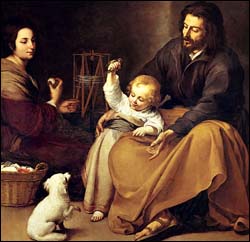
Happy Father's Day
With Mother's Day coming up, all the seminarians are busying themselves with buying cards to send home. But let's not forget fathers on this important solemnity of St Joseph, the foster father of Christ. It seems that a large part of what ails our modern culture is the crisis of fatherhood, a misunderstanding of what it means to be a father. When I was browsing the internet the other day I came across a contraceptive advert that read "MANHOOD", and which followed on to say that with the risk of sexually transmitted diseases it was important for guys to take the necessary precautions. But this is the opposite of manhood, that is, of being a person of trust, of courage, of commitment, of self-gift to others. St Joseph was not out for his own welfare, or his own gain, but his whole life was spent in the service of his spouse and his adopted child. We know hardly anything about him, and yet he is venerated as the most important saint next to Mary, because of the way he courageously and humbly participated in the mystery of God made man.
Pray that we may have true fathers in our society, who give of themselves in order to lead others to God. Pray for our bishops and priests to be encouraged today by the example of St Joseph, and pray that we seminarians may become priests who have the hearts of fathers.
Tuesday, 17 March 2009
Living in the real world
From the Devout Life today. Some words I could do with following!
I do not approve at all of a person, who is occupied in some duty or calling, wasting time in desiring some other kind of life than that which is suited to his duty, or practices incompatible with his present condition in life; for this fritters away the energies of the heart and makes it weak in carrying out necessary excercises. If I desire the solitude of the Carthusians I waste my time, and this desire takes the place of the desire which I ought to have to imploy myself well in my present office. No, I would not even wish anyone to desire to have greater talent or a better judgement, for these desires are vain and take the place of the desire which each one should have to cultivate his own talent, such as it is; nor would I desire anyone desire means of serving God which he has not, but I would have him make a good use of those which he has. Now this applies to those desires that occupy the heart; for as to simple wishes, they do no harm at all, provided that they be not frequent.
Do not desire crosses, save in proportion to the measure wherewith you have borne those that have already been sent to you; for it is an illusion to desire martyrdom, and not to have the courage to bear an injury. The enemy often suggests to us ardent desires for things that are absent and that will never come to pass, in order to divert our minds from objects that are present, and from which, however little they may be, we might derive great profit. We might fight the monsters of Africa in imagination, and from lack of attention we allow ourselves in reality to be killed by the little serpents that lie in our way. Do not desire temptations, for that would be rashness; but occupy your heart in awaiting them courageously, and in defending yourself from them when they come.
Now back to my essay!
Monday, 16 March 2009
Gossiping

From the Devout Life today:
If anyone offend not in word, says St James, the same is a perfect man. Take great care not to speak any unseemly words; for though you may not say them with a bad intention, yet those that hear them may put a different construction upon them...
Whosoever unjustly takes away his neighbour's good name, besides the sin which he commits, is bound to make reparation, though differently, according to the different kinds of detraction; for no one can enter Heaven with the goods of others, and among all exterior goods, reputation is the best. Detraction is a kind of murder, for we have three lives: the spiritual, which consists in the grace of God; the corporal, which consists in its animating principal the soul; and the social, which consists in reputation; sin takes away the first from us, death the second, and detraction the third. But the detractor, by a single stroke of his tongue, ordinarily commits three murders: he kills his own soul and that of him who listens to him by a spiritual murder, and he takes away the social life of him whom he defames; for, as St Bernard says, he that defames another and he that listens to the defamation, both have the devil on them, but one has him on his tongue, and the other in his ear. David, speaking of detractors said: They have sharpened their tongues like a sepent. Now a serpent's tongue is forked and has two points, as Aristotle says: and such is the tongue of the detractor, which with one stroke stings and poisons the ear of the listener and the reputation of him that is spoken against.
I implore you, therefore, dearest Philothea, never to defame anyone either directly or indirectly: be very careful not to impute false crimes and sins to your neighbour, nor to make known those that are secret, nor to exxaggerate those that are manifest, nor to put a bad construction on a good work, nor to deny the good that you know in a person, nor to ignore it out of malice, nor to diminish it by words...
How hard it is to live up to these words from St Francis! Blogs can often be a great source of detraction, like any other public arena. St Francis does go on to say that we should not praise another person's faults in order to avoid detraction, nor should we keep silent about them if it would be beneficial for the person in question, or for those to whom we speak, to tell them (for example, to warn younger kids about hanging around with people who are up to no good). But how often is our talk about the faults of others really helpful to anyone? How often is it just our own pride that motivates us?
Saturday, 14 March 2009
Interior conversion
From the Devout Life today:
Those who treat of husbandry and rural matters tell us that, if some word be written upon an almond that is quite sound, and if it be put back in its covering, which is carefully folded and wrapt about it, and then placed in the soil, all the fruit of the tree which grows from it will have this same word written and engraced on it. For my part, Philothea, I have never been able to approve of the method of those who, to reform a man, begin with the exterior - with the deportment, with the clothes, with the hair.
On the contrary, it seems to me that we must begin with the interior: Be converted to me, says God, with all your heart. My son, give me thy heart; for the heart being the source of our actions, they are such as is the heart. The divine Spouse in his invitation to the soul says: Put me as a seal upon thy heart, as a seal upon thy arm. Yes, truly, for whosoever has Jesus Christ in his heart, has him soon afterwards in all his exterior action.
For this cause, dear Philothea, I have desired above all things to engrave and inscribe this holy and sacred word upon your heart: Vive Jesus! I am confident that thereafter your life, which comes from your heart, as an almond-tree from its kernel, will have all its actions, which are its fruits, stamped and engraved with this same word of salvation; and that, as this sweet Jesus will live within your heart, he will also live in all your actions, and will appear in your eyes, in your mouth, in your hands, yea, even in your hair; and you will be able reverently to say, in imitation of St Paul: I live, now not I, but Christ liveth in me.
Subscribe to:
Posts (Atom)